

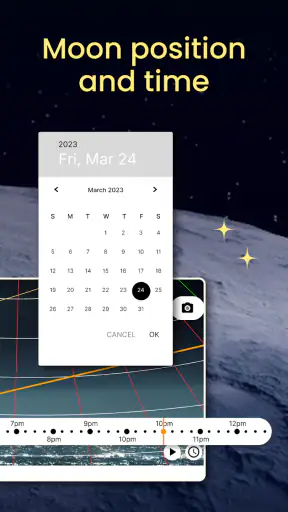
I found Moon Locator - Lunar Calendar most useful when I treated it as a practical planning companion rather than a decorative astronomy toy. It brings moon phases, a lunar calendar, and location-based moon tracking together in an Education app that is easy to understand at a glance. I could open it when I wanted to know what the Moon was doing that evening, then use the information to decide whether a walk, a photo session, or a simple bit of sky-watching was worth planning.
That approach matters because the app’s value changes with your situation. At home, with a reliable connection and time to explore, it feels informative and convenient. Outside, where reception may be weak and the phone is being used for navigation, the experience deserves more caution. I would not choose it as my only source of planning information for a remote trip, but I would gladly keep it on my phone for ordinary day-to-day moon checks.
What the app is really good at
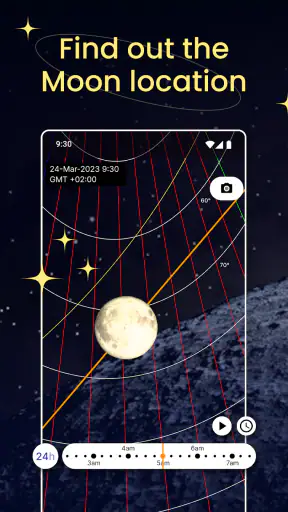
The central appeal is straightforward: Moon Locator helps turn an abstract lunar calendar into something connected to your place and your plans. Instead of remembering a phase name and guessing what it means for the evening sky, I can use the app to build a more concrete picture of the Moon’s appearance and timing. That makes it approachable for beginners who want more than a generic calendar entry but do not want a complicated astronomy tool.
It is listed as a free app, with optional in-app purchases ranging from $0.99 to $99.99 per item. That makes it easy to try before deciding whether the extra paid elements are worthwhile. The age rating is Everyone, which fits the simple educational purpose. I could see it working well for a parent answering a child’s question, a student preparing a small observation project, or an adult who wants to understand why the Moon looks different from one night to the next.
The developer is Battery Stats Saver, a name that does not immediately explain the app’s subject, so I would judge the product by the experience rather than by the developer label. The current version is 4.6.4 and it supports devices running Android 7.0 or later. That keeps it available to many older Android phones, although the actual smoothness will still depend on the handset, screen, and system condition.
Its public reception suggests that it has found a substantial audience: the app has passed one million installs, with an average rating of 4.1 from around 6,500 ratings. I read that as a sign of broad usefulness rather than proof that every user will enjoy it. A tool like this can be excellent for casual observation while still feeling limited to someone who expects the depth of a dedicated astronomy application.
Why location and connectivity affect the first impression
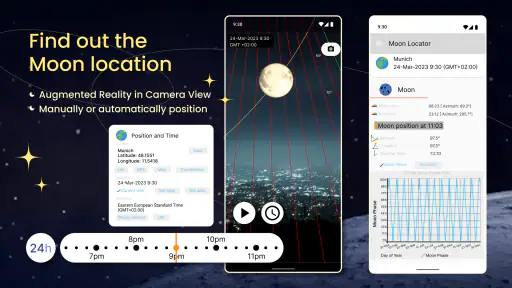
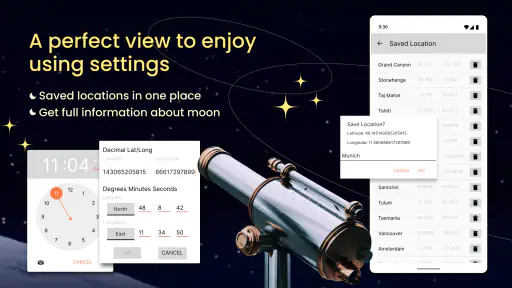
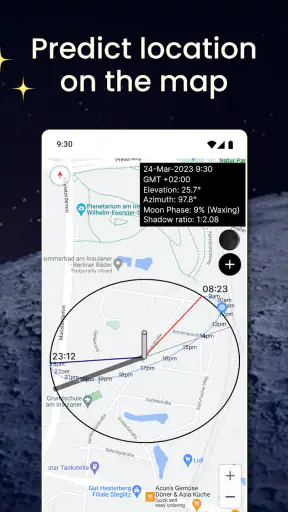
The most important practical detail is that moon information is more meaningful when it is tied to where you are. When I moved between locations, I became more aware that a moonrise or moonset time is not just a universal number. The local horizon, time zone, and position all influence how useful the information feels. That is where the locator concept earns its place instead of behaving like a static phase chart.
Network conditions can shape this process. A connected phone is the safest environment for opening the app, checking location-related information, and preparing a plan before leaving. If I were heading to a park or a viewpoint, I would load the relevant information while still at home and take a moment to note the phase and expected timing. That small habit reduces the chance of standing outside waiting for an event I did not properly check in advance.
I would not assume that every part of the experience remains equally available when the signal disappears. The app’s purpose depends on location-aware information, and the safest review of that situation is practical: test it yourself before relying on it somewhere remote. Open it in airplane mode or in a place with poor reception, then see which screens remain useful. That test is more reliable than treating any moon app as automatically independent of a network.
This is also why I prefer using it as a preparation tool rather than constantly refreshing it outdoors. A quick check before leaving gives me a reference point. Once outside, I can concentrate on the sky instead of repeatedly trying to make a weak connection cooperate. For a casual evening, that is enough. For a carefully timed observation, I would write down the important details beforehand.
Everyday mobile situations where it fits naturally
One realistic use is an evening walk after dinner. I might wonder whether the Moon will be visible above the buildings, open the app while connected to the home network, and check the lunar phase and local information before putting the phone away. The app does not need to dominate the outing. Its best role is to answer a question quickly, then let me return my attention to the surroundings.
It can also help with photography planning, especially for someone learning how changing moon phases affect a scene. A bright Moon can alter the mood of a landscape, while a thinner crescent may be easier to combine with a darker sky. I would use the app to choose a promising night, then confirm the exact view from the intended location because buildings, trees, hills, and weather can change what is actually visible.
Families may find it useful as a conversation starter. Instead of showing a child a picture of the Moon and stopping there, I can use the calendar to compare one night with another and explain that the visible shape follows a repeating cycle. The location element gives the discussion a practical connection: the same Moon is seen from different places, but the timing and position can feel different locally.
Students should approach it as a supporting reference, not as a complete science course. It can help organize an observation diary, but the strongest learning comes from combining the app with personal notes. I would record the date, approximate time, cloud conditions, where the Moon appeared, and how its visible shape compared with the app. That turns a quick lookup into a small experiment and also exposes the difference between a calculated forecast and real-world visibility.
How I would use it before leaving home
My preferred workflow has three stages. First, I open the app while the phone has a dependable connection and check the lunar calendar for the period I care about. Second, I focus on the specific evening rather than browsing endlessly through general information. Third, I save the key details in my own notes or simply remember the approximate plan before heading outside.
This workflow has a useful advantage: it separates research from observation. At home, I have time to correct the location, check the date, and think about the surroundings. Outdoors, I am less likely to waste battery, mobile data, or attention. It also gives me a fallback if the app becomes difficult to access later. I still need to verify the sky with my own eyes, but I am not starting from zero.
A less obvious benefit is that this method helps prevent overconfidence. A moon calendar can tell me when a phase or event is expected, but it cannot remove clouds, light pollution, obstructions, or an inconvenient horizon. I use the app to narrow the possibilities, not to promise a perfect viewing experience. That distinction is especially important for photography, where a technically correct time can still produce a disappointing composition.
For mobile use, I would also avoid leaving the screen active longer than necessary. The app is designed for checking information, not for replacing a dedicated camera or navigation system. If I am walking at night, I would finish the lookup before moving and keep the phone safely stored. The Moon is a reason to look up, not a reason to become distracted by a bright screen.
What happens when the connection or location is unreliable
Connectivity problems are not dramatic in the same way as a game losing progress, but they can still interrupt the experience at the wrong moment. A weak signal may make a location-based check slower or less convenient. If the phone cannot establish the information I need, I would rather have prepared earlier than depend on a last-minute refresh from a dark field or a crowded viewpoint.
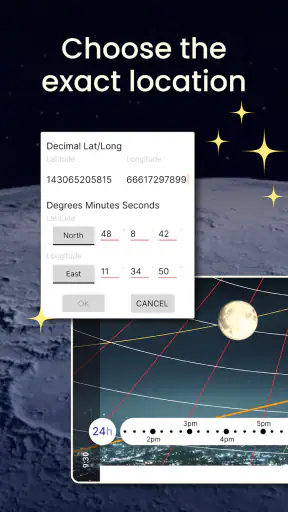
Recovery is simple when I treat the app as one part of the plan. I would move to a place with better reception, reopen the relevant screen, and confirm that the phone is using the intended location. If the result still looks wrong, I would compare the displayed date and local setting with my own calendar. Many apparent astronomy errors are really planning errors caused by the wrong evening, a changed location, or a rushed glance.
There is a useful distinction between a failed connection and a disappointing observation. If the app loads but the Moon is hidden by clouds, the app has not necessarily failed. Its information may still be correct even though the sky is uncooperative. Conversely, if the information appears inconsistent after moving across time zones or locations, I would not blindly trust the first screen. I would refresh the relevant context before making a trip around it.
For remote travel, I would use a two-source approach. I would check Moon Locator before departure, then keep a written note of the important phase and timing. A general astronomy reference or a local weather service may be a better companion for the other parts of the decision. This is not a criticism of the app so much as a recognition that moon tracking, weather, terrain, and navigation are separate problems.
Using it without wasting mobile data
Someone with a limited data plan can still use the app sensibly. The most efficient habit is to perform the main checks on Wi-Fi, especially when planning several nights or exploring the calendar. I would avoid repeatedly reopening the same information simply because I am curious. One deliberate check, followed by personal notes, is usually more useful than constant refreshing.
I would also avoid treating the app as a live outdoor companion that must remain open throughout an observation. Once I have the phase and the local timing I need, I can lock the phone and watch the sky. This reduces screen use and makes the outing feel less like a technical task. If I need another look later, I can decide whether the information is worth the connection rather than automatically using mobile data.
The free entry point is helpful here because I can test my own routine before paying for anything. I would first see whether the basic calendar and locator information fit my needs, whether the interface is comfortable on my phone, and whether the app behaves acceptably in the places where I plan to use it. Only after that would I consider an optional purchase. The wide range of possible purchase prices makes that personal trial especially important; I would inspect each paid option carefully instead of assuming every feature is necessary.
There is another practical trade-off for families and classrooms. If several people are using one phone, preparing the information once is more efficient than having every person repeatedly search for the same evening. The app can then support a shared discussion without turning the activity into a series of network requests. For a teacher, I would prepare the relevant dates in advance and use students’ own observations to fill in what the app cannot show, such as clouds and local obstructions.
Where it beats ordinary alternatives, and where it does not
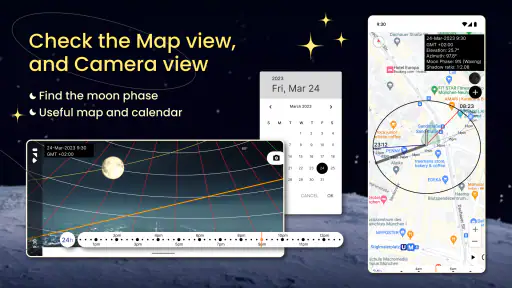
Compared with a basic calendar, Moon Locator offers a more direct connection between the date, the lunar phase, and the local viewing context. A normal calendar may remind me of a full Moon, but it does not naturally encourage me to think about where the Moon will be or how a particular evening might look. For casual planning, that extra context is the reason to choose this app.
Compared with a broad stargazing application, it is more focused. A full astronomy app may cover planets, stars, constellations, sky maps, and observation tools, making it a better choice for someone who wants to identify everything overhead. I would choose that alternative for a serious observing session. I would choose Moon Locator when my question is specifically about the Moon and I want a less crowded experience.
Compared with a web search, the app feels more convenient for repeated checks because the lunar information is organized around the task. A search engine can answer a single question quickly, but it may require sorting through different sources and repeating the process whenever the location or date changes. The app’s focused format is better for a person who checks the Moon regularly, while the web remains useful for confirming weather, visibility, or local conditions.
Its limitation is the same as its focus. If I want detailed astrophotography planning, telescope guidance, a complete sky map, or a broader explanation of celestial mechanics, I would look elsewhere. The app can begin an astronomy habit, but it should not be mistaken for a full observatory toolkit. Its educational value is strongest when I use it to guide observation and curiosity rather than expecting it to answer every question about the night sky.
Who should install it and who should skip it
I recommend it to casual sky-watchers, families, students, photographers who want a simple lunar planning aid, and anyone who often asks whether the Moon will be visible during an evening activity. It is also a reasonable first step for people who find advanced astronomy apps intimidating. The Everyone rating and free starting point make experimentation easy, while the location-based focus gives the app more purpose than a static image of the lunar cycle.
I would be more cautious about recommending it to an experienced astronomer who already uses a detailed planning suite. That person may find the focused feature set too narrow. I would also skip it as a sole tool for remote expeditions, especially when reception is uncertain. In that situation, preparation, written notes, weather information, and a dependable navigation method matter more than having a moon interface available at the exact moment.
People who dislike location-aware experiences should think about their comfort before installing. The app’s central idea is tied to knowing where the Moon is relevant to the user, so its usefulness depends on accepting that context. If I only want a general phase chart and do not care about local timing or position, a simpler calendar may be enough.
Finally, I would not install it expecting a game, a social community, or a deep course in astronomy. It is an educational utility. Its reward is practical understanding: checking a phase, planning a viewing opportunity, and comparing the forecast with what appears in the sky. That modest purpose is a strength when it matches the user’s needs, but a weakness when someone expects a much larger feature set.
My final view after using it as a planning tool
Moon Locator - Lunar Calendar works best when I prepare with it, then put the phone away. Its lunar calendar and location-oriented approach make ordinary questions about the Moon easier to answer, and the focused design is friendlier than many all-purpose astronomy tools. I especially like the idea of checking it at home, noting the important details, and using the outdoor session for actual observation rather than constant screen time.
The connectivity angle keeps the recommendation realistic. I would not assume that a remote location will offer the same smooth experience as a connected home network, and I would test the app before depending on it away from reliable service. Preparing in advance, keeping a short backup note, and using other tools for weather or navigation remove most of the practical friction.
With its free starting point, broad Android compatibility, and established audience, it is easy to try without turning the decision into a major commitment. The optional purchases mean I would review the value of each upgrade carefully, but I would not pay simply because the app is interesting. I would pay only if a specific addition improves the way I plan or learn.
My recommendation is simple: choose it if you want an accessible, location-aware lunar calendar for everyday planning, but pair it with your own observation and sensible preparation when connectivity is uncertain. For a beginner or casual Moon watcher, that balance makes it a useful addition to an Android phone. For advanced astronomy, offline-critical travel, or full-sky exploration, a more specialized alternative will be the better fit.


